 BEAD Ops
Every SAR Field. Every CSV. Validated Before You Submit.
BEAD Ops generates all seven structured CSV datasets, narrative report sections, financial tables, and compliance attestations required by the NTIA Semi-Annual Performance Report v2.0—grounded in your live project registry, BSL and CAI locations, and subgrantee submissions.
SAR v2.0 is unforgiving at scale.
NTIA’s Semi-Annual Performance Report is not a narrative memo with attachments. It is a federated data submission: seven interrelated CSV files, each carrying dozens of mandatory fields per row, strict data typing, enumerated domains, and cross-file keys that must reconcile in NGP.
A single misformatted field—a blank where a code is required, a decimal where an integer is enforced, a location ID that does not match the Fabric version in scope—can fail validation and hold an entire SAR package while your office chases fixes across subgrantees, PM firms, and internal spreadsheets.
warning Why states hit the wall
- datasetStructured CSV, not summaries. SAR v2.0 requires row-level records for subgrantees, deployment projects, served BSLs, excluded locations, served CAIs, digital equity contracts, and broadband office staffing—each with field-level rules.
- ruleNGP validation is the real QA. Data types, required fields, enumerated values, and referential checks are enforced at upload. There is no “good enough” partial pass for a file that other files depend on.
- groupsPortfolio scale compounds risk. Offices managing 20–50+ subgrantees, hundreds of projects, and hundreds of thousands of BSLs cannot afford row-by-row manual inspection in Excel every reporting period.
BEAD Ops closes the loop: operational data captured during deployment, compliance, and subgrantee reporting is the generation source for SAR exports—then validated against the same constraints NGP will enforce, before your team burns cycles on rejected uploads.
All seven SAR CSV files—generated from your registry.
Each filename uses your state abbreviation prefix [XX] per NTIA convention. Below is what each file carries and how BEAD Ops maps operational records into SAR-ready rows.
Subgrantee roster & program facts
Row-per-subgrantee facts NTIA uses to reconcile awards across the portfolio.
- • UEI, FRN, consortium status
- • Jobs created/retained (where applicable)
- • Subscriber and network availability indicators per schema
Deployment project registry (30+ fields)
The structural backbone tying dollars, technology, and schedule to NTIA’s project-level SAR expectations.
- • Eligible use allocations, project status, construction phase
- • Build progress, LEO capacity fields where applicable
- • Financials, extensions, scope modifications
Served Broadband Serviceable Locations
Location-level service assertions aligned to Fabric identifiers your office already tracks.
- • Location ID, Project ID, FRN
- • Service designation, speeds, technology code
Locations excluded from BEAD-funded service
Defensible documentation for locations that will not receive BEAD-funded service under approved criteria.
- • Location ID, classification, reason codes
- • Evidence types, Fabric version references
Served Community Anchor Institutions
CAI connectivity outcomes tied to funded projects and location keys.
- • Location ID, Project ID, address
- • Coordinate fields per schema
Digital equity & workforce contracts
Contract-level reporting for eligible equity and workforce investments.
- • Contractor, contract ID, type, amount, status
- • Expenditures, jobs metrics per row rules
State broadband office staffing (EE)
Captures how BEAD-funded staffing supports program administration and eligible equity activities—typed fields for titles, employment categories, and FTE.
- • Position title and position type
- • Job created / retained flags where applicable
- • FTE percentage fields per SAR schema
Catch NGP failures before you open the Grants Portal.
BEAD Ops validates generated CSVs against NGP data type requirements, enumerated value constraints, required field rules, and cross-row dependencies—mirroring the failure modes teams see in NTIA’s “Fix Validation Problems” workflow, without spending upload slots on preventable errors.
Data types & format rules
Integers, decimals, dates, and fixed-width codes are enforced at export—so you do not discover a type mismatch after a 200 MB upload times out.
Enumerated domains & required fields
Picklists and conditional requirements from SAR v2.0 are encoded in validation logic, not tribal knowledge in a shared drive.
Error reporting aligned to NGP workflows
Issues are reported with file, row, and field context so subgrantees and PM staff can remediate at the source—then regenerate cleanly.
State abbreviation prefix enforcement
Filenames and embedded keys follow [XX]_ conventions so packages stay consistent across reporting periods and audit trails.
cloud_upload NGP-ready handoff
Validation in BEAD Ops is not a substitute for NTIA’s final acceptance—it is the quality gate that prevents your office from becoming a human CSV debugger during the SAR window. Teams ship packages when internal checks pass; NGP becomes confirmation, not triage.
SAR is more than CSV—BEAD Ops supports the full submission stack.
Narrative sections and federal financial exhibits must cite the same projects, locations, and cost categories your structured files assert. BEAD Ops keeps those narratives and tables tied to operational records—not retyped from stale PDFs.
article Narrative report support
- Section 5 — FPFR: Summaries with project-specific citations drawn from documented FPFR milestones and registry status—so prose matches what NTIA can trace to project IDs and dates.
- Section 8 — Use of Funds: Planned versus actual tables by NTIA cost category, aligned to disbursement and cost tracking in BEAD Ops.
- Section 9 — Supplementary information: Structured inputs for state-specific exhibits and contextual notes that still map back to controlled data fields.
- Section 10 — Certification support: Checklists and sign-off flows that bundle attestations with the underlying evidence trail.
request_quote Federal financial forms
Financial reporting in SAR cycles includes standardized federal forms that must reconcile to cash management and project costs. BEAD Ops surfaces the figures your finance team needs in formats consistent with SF-425 (Federal Financial Report), SF-429 (Real Property Status), and SF-428 (Tangible Personal Property)—reducing last-minute reconciliation between accounting and program systems.
Compliance statements backed by operational proof.
SAR certifications are not checkbox theater when auditors and NTIA can trace each assertion to manufacturer letters, environmental reviews, NTP dates, and subgrantee attestations stored in BEAD Ops.
BABA — domestic manufacturing
Manufacturer certifications and attestation workflows for eligible equipment tie directly to EE contract rows and subgrantee records—so BABA statements in SAR map to named vendors, part categories, and documentation dates.
Secure and Trusted Communications Networks Act
Compliance reviews and prohibited equipment checks are tracked per project and subgrantee, supporting statutory attestations without parallel spreadsheets.
Subgrantee reporting — NOFO VII.E.2
Reporting tiers (monthly, semi-annual, annual) are enforced through the subgrantee portal; missing or late submissions surface before SAR assembly—so state certifications reflect actual submission status.
ISP reporting tiers—in the same portal as SAR prep.
Subgrantees do not experience BEAD Ops as “another state form.” They see tiered reporting cadences with clear due dates, validation feedback, and linkage to payment requests—feeding the same registry your SAR CSVs export.
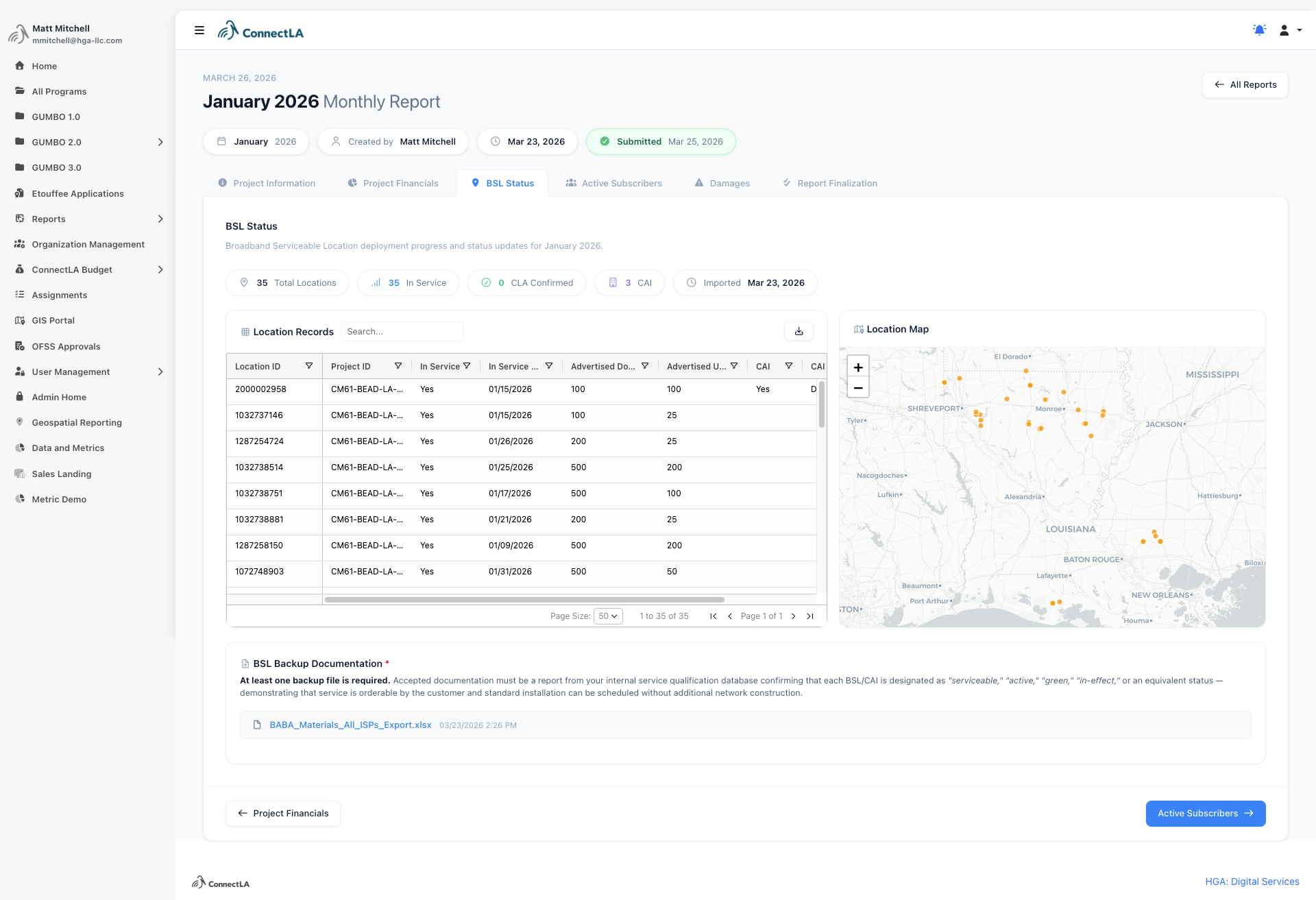
Project-level monthly report detail — miles constructed, milestones, expenditures, and location status in one structured view.
Monthly
- • Miles constructed and physical build indicators
- • Location milestones and connection counts
- • Expenditure summaries tied to project IDs
- • Utility damage incidents for trend analysis
Semi-Annual
- • Location-level service data feeding SAR BSL/CAI files
- • Speed tiers, pricing, and technology codes
- • Federal financial form inputs aligned to SAR tables
- • Compliance documentation uploads with review status
Annual
- • Subscription rates and affordability metrics
- • Right-of-way fee reporting where required
- • FCC attestation workflows
- • Executive compensation disclosures per federal rules
Stop debugging CSVs in the NGP upload queue.
Book a technical walkthrough: we will trace a reporting period from subgrantee submissions through validation to SAR export—on the timelines your office actually faces.
Schedule a demo arrow_forwardHome · Resources · Case study