 BEAD Ops
Your Reporting Portal. Built for Speed, Not Paperwork.
BEAD Ops gives ISP subgrantees a structured portal for submitting every required report, payment request, and compliance document — without spreadsheets, email chains, or guesswork.
The same workflows your state uses for NTIA Semi-Annual Reporting (SAR) and Grant Solutions tie back to what you submit here: BSL and CAI location data, financial reports, and attestations stay aligned from the field to federal filing.
What subgrantees do in BEAD Ops
Every BEAD obligation your state and NTIA require — captured in one portal with standardized templates, validations, and audit trails.
- • Submissions map to state-defined schedules and NOFO-driven milestones — not generic project-management tasks.
- • Attachments, certifications, and location-level detail stay versioned for audit and corrective action.
- • When your state approves data, it rolls forward into SAR datasets and executive reporting without re-entry.
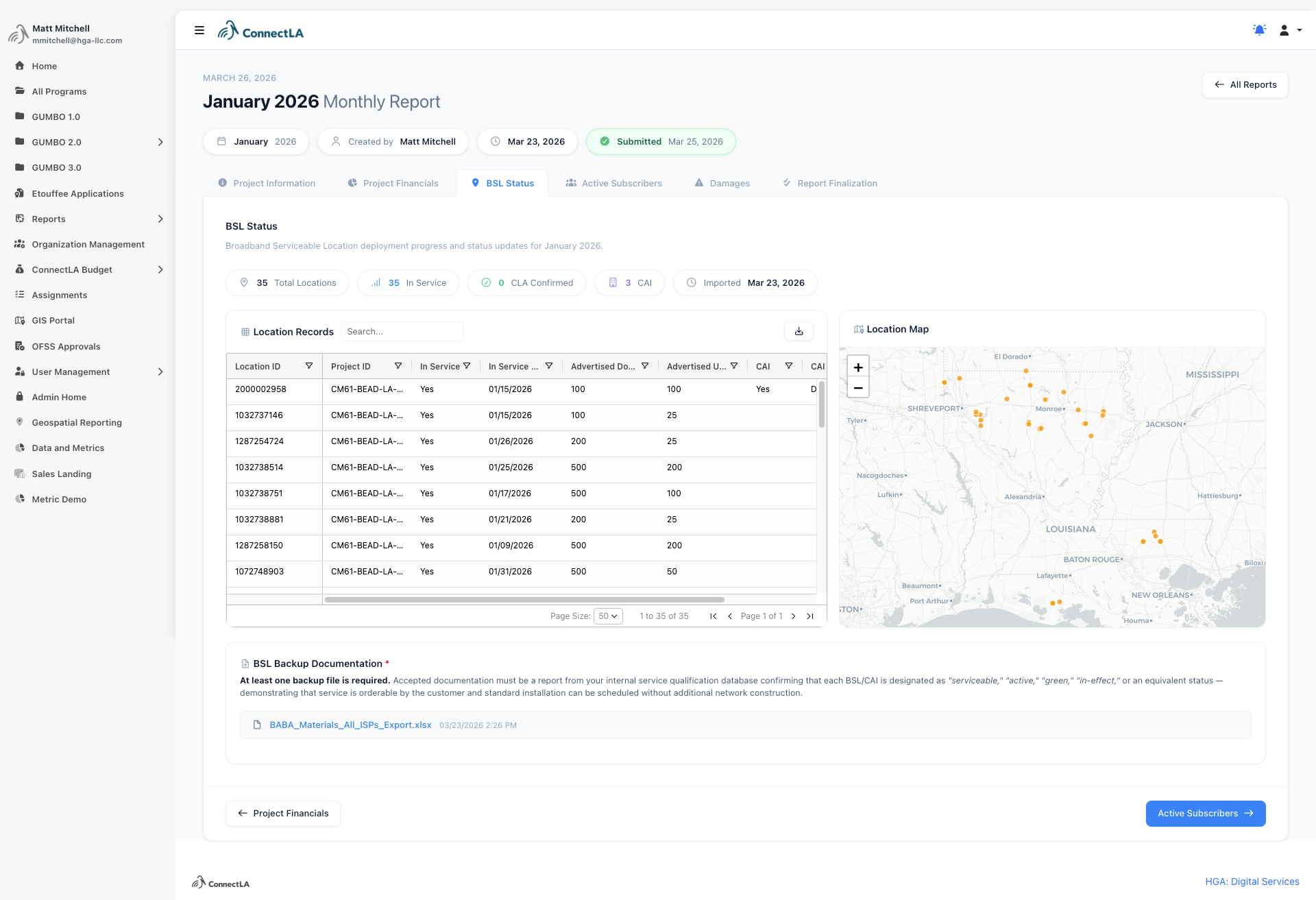
Monthly Progress Reports
Miles of network constructed, location-level milestone status, new end-user connections, award funds expended, underground utility damage incidents, and project cost summaries using standardized templates.
Semi-Annual Reports
Location-level data for all BSLs and CAIs: service status, technology type, advertised speeds and pricing, types of facilities constructed, peak and off-peak speeds, federal financial reports (SF-425, SF-429, SF-428), and AOR certification.
Annual Reports
Residential and commercial location counts, subscription rates, average subscription counts, ROW fees, permit fees, franchise fees, delay documentation, FCC attestation evidence, and executive compensation under 2 CFR Part 170.
Payment Requests
Milestone-based disbursement submissions with certifications: qualifying broadband service availability at relevant thresholds, match fund proportionality certification, and project cost reports using the full cost template across SGA-defined categories.
BABA Documentation
Submit manufacturer certification letters, waived electronics documentation, and de minimis waiver evidence. Track product compliance categorization in one place.
Location Updates
Update BSL status from deployment through service activation. Report technology codes, advertised speeds, service designations, and FRN when service goes live.
How it works
A straight line from state configuration to NTIA-ready SAR data — no re-keying, no shadow systems.
Your UEI, project identifiers, and location inventory carry through each reporting period. State reviewers see the same records you see, which cuts down on clarification rounds and speeds payment decisions when milestones are met.
-
1
Configure
The state office configures reporting requirements and schedules.
-
2
Receive forms
Subgrantees receive structured forms with pre-populated project data.
-
3
Submit
Submit reports through the portal with required attachments.
-
4
Review
The state office reviews, validates, and approves or requests corrections.
-
5
SAR flow
Approved data flows directly into NTIA SAR generation.
Underground utility damage: structured from the field to the monthly report
BEAD Ops treats utility strikes as first-class data — not an afterthought in a PDF attachment. That keeps you aligned with state mandatory reporting and integrates cleanly with monthly progress reporting.
- check_circle Structured incident reporting — location, date, utility type, cause, and severity in defined fields.
- check_circle Mandatory reporting compliance — built for state law requirements, not ad hoc narratives.
- check_circle 811 call-before-you-dig documentation — capture evidence the way reviewers expect it.
- check_circle Automatic integration with monthly progress reports — one source of truth.
Why it matters
States are under pressure to prove oversight. ISPs need a portal that makes incident data consistent, timely, and tied to construction milestones. BEAD Ops closes that gap in production — not on a roadmap.
How your submissions connect upstream
Subgrantee data is the foundation for state compliance and NTIA reporting. These pages describe what happens after your portal submissions are validated.
NTIA reporting
Semi-annual SAR obligations — structured CSVs, financial tables, narratives, and pre-submission validation — draw from the same operational facts you enter as a subgrantee.
Explore NTIA reporting arrow_forwardCompliance stack
BABA, NEPA, permitting, and match-fund rules do not live in silos. The portal ties documentation to projects and milestones so states can defend every dollar.
Compliance overview arrow_forwardBenefits for ISPs
Clear requirements
Know exactly what is needed and when — tied to your award and state NOFO.
Structured forms
No ambiguity about data format, fields, or NTIA CSV alignment.
Real-time status
See where your submissions stand in the state review workflow.
Payment transparency
Track the disbursement pipeline and milestone progress alongside documentation.
BEAD Ops is live in production for early-deployment states. If your award is active, expect the same rigor Louisiana and peer programs apply: defined fields, mandatory attachments, and reviewer feedback in-system — not buried in email threads.
Already a BEAD subgrantee?
Contact your state broadband office for portal access. State teams run provisioning, roles, and program rules in BEAD Ops — you get the same production system Louisiana and other early-deployment states use today.